• Proudly presenting the original English version of an article by Jeffrey Gedmin, published Dec. 27, 2006, in WELT:

    “Best of 2006” / By Jeffrey Gedmin

    As we finish the year, here’s my best of 2006 and predictions for 07. Best Book:The Kite Runner. First novel of an Afghan doctor living in California. The story of two boys growing up in Afghanistan. Something devastating happens that changes the boys’ lives. Inspiring and beautifully written. Best Restaurant: “Dadarski’s cooking school” in Berlin. Rent it for a small celebration. Cook along. Best Film: “Heart of the Game”. Documentation about a girls’ high school basketball team in Seattle. Multiracial team and unorthodox white male coach train hard, suffer together, overcome adversity and have huge amounts of fun. Best gadget: E-Book now out from Sony. Light little screen, this new toy allows you to store up to 80 books in its memory. Download a book in a New York minute.

    Best political decision: Bush’s to fire Donald Rumsfeld. I liked Rummy. I never understood, though, why he resisted so mightily in putting more U.S. troops in Iraq. Best beach: Tel Aviv. Long and wide, soft white sand. Fresh fish, spectacular salads. Atmosphere feels like the best of Greece and southern California. Best Chinese Restaurant: China Tang in London’s Dorchester Hotel. 1930s Shanghai feeling. Disadvantage: crazy expensive. Advantage: bar is fantastic if you decide on just a drink and appetizer. Best political joke: Young Israeli guy arrives in London and forgets to fill

  • (By Ray D.)

    Majorities in USA and Europe Favor Saddam Execution

    The recent results of a poll conducted by Novatris/Harris for the French daily Le Monde on the death penalty shocked the editors and writers at Germany’s left-leaning SPIEGEL ONLINE. When asked whether they favored the death penalty for Saddam Hussein, a majority of respondents in Germany, France and Spain responded in the affirmative. Here the results by country:

    Percentage of respondents in favor of executing Saddam Hussein:

    USA: 82%
    Great Britain: 69%
    France: 58%
    Germany: 53%
    Spain: 51%
    Italy: 46%

    Clearly, there is a gap between the United States and the European nations polled. On the other hand, the western Europeans polled demonstrated that there is majority support for the death penalty in particular cases. In other words, the gap that exists across the Atlantic is not at all the clear-cut, “black-white” divide that some in media make it out to be.

    Die Zeit: “The Europeans condemn the use of the death penalty” / Do they? The poll numbers above contradict that assumption.
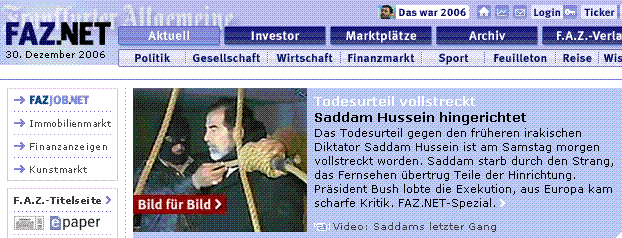
    Frankfurter Allgemeine: “President Bush praised the execution, from Europe came sharp criticism.” / A tempting -and in the media oft used- opportunity to again pit “Europe” against Bush. A more intellectually honest headline would have pointed out that the majority of the criticism coming from “Europe” has emanated from a tiny media-political elite. The rest of society is evenly divided.
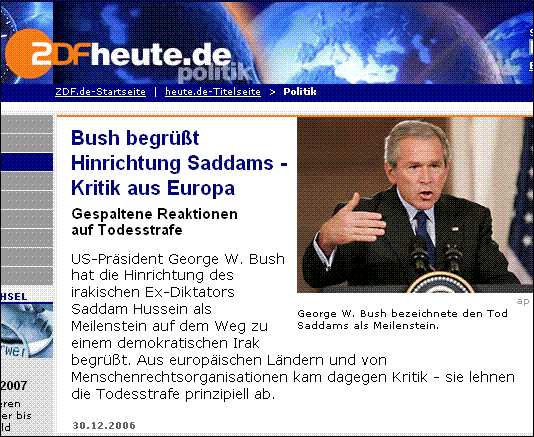
    ZDF Heute Online: “Bush Welcomes Saddam’s Execution – Criticism from Europe: Divided Reactions to Death Penalty: US President George W. Bush greeted the execution of Saddam Hussein as a milestone on the way to a democratic Iraq. In contrast, criticism came from European countries and human rights organizations – they reject the death penalty as a matter of principle.” / ZDF is clearly attempting to create an “us versus them” – “Europe versus Bush and America” wedge issue out of the death penalty. This piece also totally ignores the opinions of the average German.
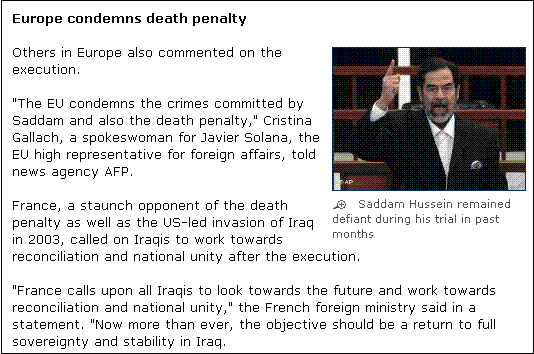
    Deutsche Welle: “Europe condemns death penalty” / But what about the more than half the population in Germany and other European nations that does not condemn it in Saddam’s case? Do they simply not matter? Do they somehow not exist for certain media-political elites? Why are their views systematically ignored?

    Sueddeutsche published a piece entitled: “Worldwide Sharp Criticism of the Execution.” The piece goes nation by nation and lists criticisms as if they represented the view of the entire country. It does not mention poll results that indicate majorities in many of the same countries actually favored Saddam’s execution.

    Other media outlets, including Financial Times Deutschland and even SPIEGEL ONLINE have actually treated the death penalty question as a debate instead of falsely claiming that an imaginary, monolithic “Europe” has “sharply criticized” Saddam’s execution. Another major theme in most of the Western media is that Saddam’s execution does not help Iraq – in other words, more of the usual pessimism.

    Additionally, there has long been a heated debate on the death penalty in the United States. Several U.S. states do not legally permit executions or do not make (wide) use of them. From the mid 1960s to the mid 1980s, executions came to a near standstill in the United States, in part because of legal challenges which culminated in the Supreme Court’s 1972 Furman vs. Georgia decision. Recently, a botched execution in Florida led Republican Governor Jeb Bush to suspend the death penalty as a federal judge in California imposed a moratorium halting executions in that state. 

    Put another way: There is a lively debate on the death penalty on both sides of the Atlantic, with significant numbers and powerful factions on either side. Unfortunately, many in the German media have made death penalty out to be a divisive, “good versus evil” wedge issue. This stems in part from the transatlantic legal contrast: Most European nations have banned the death penalty while it remains legal in much of the United States.

    The desire in influential segments of German media and society to reduce the death penalty to the level of a transatlantic wedge issue is also deeply rooted in another key factor: Ideology. The far-left in Germany is a political force to be reckoned with. Its representatives dominate wide swaths of the media, academia and certain political parties including the SPD, Greens and the PDS. Not only do representatives of the far-left reject the death penalty in all cases (putting them at odds with many ordinary Germans), they also oppose American-style free-market capitalism, smaller, less restrictive government, and the projection of American power in the world. This movement consists largely of an assortment of 68-radicals (including ex-Maoists, Leninists, RAF sympathizers, and your run-of-the mill Socialist demonstrators); ex-eastern-bloc-Communists; young people radicalized through academia, media and far-left political parties and movements; and out-and-out America-haters. Quite honestly, these folks would have rejected the execution of Hitler and Eichmann just as they reject the execution of Saddam. Ironically, they see the issue as a “black-and-white” – “with us or against us” issue. (Sound familiar?)

    Nonetheless the death penalty remains contentious. Conservatives, libertarians and European Liberale, who traditionally favor a less powerful, less intrusive government, must ask themselves if they trust the state to determine who should live and who should die. Furthermore, they must consider whether the death penalty in the United States has become so legally contentious (filled with endless appeals, challenges and expenses) that it is practically (if not also ethically) questionable?

    These are the debates that citizens on both sides of the Atlantic should be having with one another and not against one another, as many on the far-left would have it. The real “wedge”, in this and many other cases, is not a transatlantic one. The real “wedge” is and has long been firmly lodged between the Angry left and the rest of society.

    As the poll numbers above demonstrate, the peoples of the United States and Europe are not nearly as far apart on the death penalty as some would have us believe. Sadly, in a media culture that thrives on creating new controversies and divisions and exacerbating old ones (whether real or imagined) you might never know it.

    UPDATE: Watch the full Saddam execution here:

    A quick and painless death for a tyrant responsible for the murder and torture of so many.

    UPDATE #2: Another poll conducted for the far-left publication stern confirms that significantly more Germans support the death penalty for Saddam than oppose it. The results of that poll:

    In favor of executing Saddam: 50%
    Against executing Saddam: 39%
    Don’t know: 11%

    The image “https://medienkritik.blog/wp-content/uploads/2026/05/saddamgrafik_250.gif” cannot be displayed, because it contains errors.

    Stern graphic: “No Mercy for Saddam: Should the death penalty be enforced against Saddam Hussein?”

    Stern may be a populist, trashy, anti-American media outlet, but they sure can put together a good graphic!

  • From the country of moral superiority:

    Linde investigated over alleged bribery in UN Iraq aid programme – report

    Linde AG (one of Germany’s largest companies) is being investigated over bribery allegations linked to the UN Oil-for-Food programme in Iraq, the weekly Focus reported in a prerelease of its upcoming edition, citing Munich’s head prosecuting attorney Anton Winkler.  (…)

    According to a UN report, Linde was one of more than 2,000 firms around the world alleged to have made illicit payments to Saddam Hussein’s government to profit from the aid programme, the magazine said. It also said that 63 German companies were allegedly involved and that currently up to 36 preliminary proceedings against executives of those mostly smaller firms are pending.

    63 German companies? There was little discussion in the German media about bribery charges against German companies doing business in Iraq during Saddam’s reign. There were so many other interesting topics to cover…

  • (DEUTSCHE ÜBERSETZUNG HIER / GERMAN TRANSLATION HERE)

    UPDATE: Victory for Davids Medienkritik: Stern Drops Hate-America Headline

    Subject: Stern Magazine Online: “Americans Could Care Less About the Rest of Humanity”

    To the editors and staff of Stern.de:

    I am writing this letter to express deep concern about your series entitled “The History of the USA.” This series, which has been a feature on your website for several years, includes the following headline:

    “The History of the USA: No nation has ever dominated the globe like the USA. And its people could care less about the rest of humanity.” (circled below)

    This statement is particularly troubling because it demonizes an entire nation as indifferent, uncaring and unconcerned with anyone or anything beyond its national boundaries. The series headline, published for all of Stern’s readers to see, openly declares that all Americans could care less about the rest of humanity. Not only is it patently false for reasons too numerous to list here, it is also slanderous, bigoted and profoundly ignorant. In a legal sense, it may actually violate German laws against Volksverhetzung. Whatever the legal implications may be, one honestly must ask: How could any thinking person claim or even imply that all 300 million Americans, taken individually or as a whole, are indifferent to the fate of the rest of humanity? How can a publication like Stern Online, read by millions of Germans, allow such an obviously stupid and hateful statement to accompany a series on American history for years on end?

    In closing, the above-mentioned headline is all the more troubling because your publication has a long and ugly history of exploiting anti-American sentiment to boost magazine sales and increase profits. Let me point out just a few recent examples (more here):


    How America lied to the World / Method Wild-West

    The incredible lack of journalistic integrity and responsibility displayed in Stern’s “The History of the USA” series and in many other Stern articles is deeply troubling to the readership of Davids Medienkritik. We ask that you remove the statement in question and offer your readers a full and public apology. We sincerely hope that, in the future, your publication will refrain from the opportunistic exploitation of your readership’s anti-American sentiments.

    Sincerely Yours,

    David Kaspar
    Davids Medienkritik

    Note to readers: Stern is one of Germany’s most popular, widely read weekly magazines. If you would like to join us in calling for the removal of the above statement, Stern can be contacted HERE. Instructions:

    1. Select “stern.de” and click red Empfänger auswählen button.
    2. Select “Kritik am Online-Angebot”.
    3. Enter your first/last name (Vorname, Name), email address (Email), subject (Betreff), and message (Nachricht).
    4. Click red “Nachricht absenden” button to send.

    Feel free to write in the language of your choice and keep your comments civil and respectful.

    UPDATE: Politically Incorrect has joined our effort.

  • The following is a five-part essay that appeared in the October 1934 edition of The American Mercury, a monthly magazine that featured writings on politics, foreign affairs, literature and events of the day. It is an in depth explanation of how Germans, an advanced and educated people, could support and condone Hitler and the Nazi movement.

    The author, S. Miles Bouton, can only be described as prophetic in his evaluation of of Nazism and its implications for Germany and the world. His observations on German culture, behavior and character, though occasionally anecdotal, offer fascinating insight. They also offer a unique historic window on Germany and German society at a critical moment in history. For that reason, we have retyped the unabridged text for our readers’ consideration. Links have been added to provide additional historic context:

    WHY GERMANY ENDURES HITLER

    BY S. MILES BOUTON

        How could Germany descend to the depths of brutality
    and ruthless crushing of all human rights that have marked the course of National Socialist rule from the beginning, culminating in the barbarous
    murders of June 30
    last and the following days? The Germans are admittedly the
    best educated people in the world. Their contributions to the arts and sciences
    have been impressive, their contributions to letters respectable. On the purely
    material side of civilization Germany is a good half century in advance of the
    rest of Europe. There are probably more bathtubs in Berlin alone than in any
    entire country on the Continent.
        Why have not the Germans risen up
    against the crazed gangsters who have made the name of their fatherland a
    byword in the civilized world – who have placed a stain on it which a whole
    generation will not be able to wipe out? The history of most European countries
    and even of little Ireland is full of the names of voluntary martyrs, of men
    and women who deliberately courted death in opposing despotism. The revolution
    of November, 1918, in Germany produced only four genuine martyrs; two of these
    were Karl Liebknecht, the half-Jew, and Rosa Luxemburg, Polish Jewess; and Nazi
    Germany’s history contains no such names. The men and women clubbed to death,
    “shot while trying to escape,” “suicided” or slain by firing squads or
    murderous Black Shirts were done to death merely because of their opinions or
    their race. There are millions of Germans who hate Naziism and all its works.
    But even at the very beginning, when resolute opposition would have availed
    much, they kept silent, or permitted themselves to be “coordinated.”
        The reasons for all this are to be
    found in German history. They have nothing to do with race or blood. The
    “Aryan,” “Nordic Germanic” theories of Hitler and his followers are utter
    nonsense. The Germans are a conglomerate of many races–ancient Pruzzen, Wend,
    Sorb, Lithuanian, Celt, Alpine and other blood–yet the reactions and psychology
    of all these different races and mixtures are essentially the same in respect
    of the important phases of life and thought. They have been shaped in the same
    mold, chiefly a Prussian mold, by a common history and a common language. One
    notes the same process in America. Young immigrants settling in the East begin
    talking through their nose, chewing gum and reacting to their other
    surroundings precisely like native Americans within ten years. The German,
    smitten on the nose in Germany, calls for the police. Give him ten years in
    America, and he smites back.
        The end of the Thirty Years’ War
    found Germany’s intellectual and cultural life all but utterly destroyed. The
    century produced a few men prominent in physical science, but no literary light
    or other cultural leader to compare with dozens of names in France and England,
    which steadily increased their lead. French became the language of courtiers
    and the best society, and its influence grew as a result of the immigration of
    the Huguenots. King Frederick William I did not feel it necessary to have his
    children taught German. Frederick the Great wrote all his works in French, and
    spoke German–only to underlings who did not understand the more “elegant”
    French. Leibnitz wrote some of his principal works in French, and the same was
    true of other leaders of thought in his century. The only voice raised against
    this came from Moses Mendelssohn, the Jew, the great philosopher and great
    German patriot.
        It must be remembered also that
    Prussia and almost all other German states were under absolutist rule for more
    than six centuries after Magna Charta had been granted the English by a
    reluctant King, and for three-quarters of a century after the Constitution of
    the United States was adopted.

  • In an interview with public tv channel ARD’s news programme tagesschau, former German UN ambassador Gunter Pleuger offers an enthusiastic evaluation of Kofi Annan:

    “…a man of hugh integrity…great charisma…he took great interest in Germany…no other country he visited more often…great respect for him in (German) politics and in academia…

    (Pleuger is a long-time fan of Kofi, as we have reported before.)

    In other news:

    Mystery Surfaces Over Apartment of Kofi Annan

    As Secretary-General Annan prepares to leave his post at the United Nations, a mystery is surfacing surrounding his apartment on Roosevelt Island, subsidized by New York taxpayers, which is still in use by the family of his brother, Kobina Annan.

    The apartment was where Mr. Annan and his wife lived before 1997, when he became secretary-general. The Roosevelt Island home is part of an estate of low-rent state-regulated housing. For years, the Annans saved considerable sums by occupying an apartment meant to help financially strapped low- to moderate-income New York families.

    One question Mr. Annan has never addressed is why he and his wife felt comfortable availing themselves of this generous arrangement. Another is how it is that, since Mr. Annan and his wife left that Roosevelt Island apartment 10 years ago to move into the rent-free residence on Sutton Place supplied to the secretary-general, their former low-rent apartment was handed over to be occupied by the family of Mr. Annan’s brother.

    …the current effective taxpayer subsidy for the Annan apartment could, by a conservative estimate, amount to upward of $10,000 a year, or even as much as twice that, which, over a decade, adds up to a significant sum.

    (BTW, Mr. Annan’s brother Kobina is Ghana’s ambassador to Marocco. Also, he seems to have a knack for making money, as this report on his involvement in the oil-for-food scheme shows.)

    For some strange reason, I cannot find any mention of this smart rent saving scheme of Kofi in the German media…

    They are probably still busy translating the piece.

    Yes, I believe that’s the case.

  • Take note, Texan cowboy in the White House: here’s an example of nuanced German style diplomacy.

    German diplomats don’t shoot from the hip – they talk even to hard core dictators, such as Syria’s Assad. And Germany’s foreign minister Steinmeier didn’t mince his words:

    “I call on Syria to desist from all actions that could contribute directly or indirectly to the destabilization of the situation,” he said before boarding his return flight from Damascus to Germany: “If you follow this path, you will have a partner in Germany.”

    Hey, Germany’s carrot and stick approach has worked before! Remember Steinmeier predecessor Joschka Fischer’s sensational diplomatic success in the case of Iran’s nuclear ambitions?

    Here we go again. The results of Steinmeiers’s Syrian talks so far are truly encouraging:

    Nil. Zero. Nought.

    Steinmeier himself is unable to present any meaningful reaction of Assad to his proposals. Reporting in the Syrian media is somewhat sparse.

    Anyway, as I said, Steinmeier talked to Assad.

  • Proudly presenting the original English version of an article by Jeffrey Gedmin, published Dec. 13, 2006, in WELT: “Iran – Es fehlt ein kleines bißchen Realismus“.

    Talk Syria and Iran?
    By Jeffrey Gedmin

    Ruprecht Polenz (CDU), the chairman of the Bundestag foreign affairs committee, has told the Tagesspiegel the U.S needs to talk to Syria and Iran. The Tagesspiegel got so excited it ran as a front page headline the quote, “Bush needs to swallow his pride.” Polenz knows better. The United States talks to Syria. Washington has probed conversations with Iran. The issue is not whether we talk, but rather what we negotiate with these regimes.

    It is no surprise that publication of the Iraq Study Group report, an effort led by former Secretary of State James Baker, would inspire the enthusiasts of interest-driven Realpolitik, apparently both on the Right and the Left.

    We all agree that Syria and Iran help to promote the terrorism in Iraq. We should agree, amidst all the chatter about “constructive dialogue” with Syria and Iran, that in Europe economic interests play an especially important role in shaping foreign policy choices. Germany has a special stake in the case of Iran, for example. We can agree that talking with adversaries is not an unreasonable thing to do. We talked with the Soviet Union.

    What I am still missing from the so-called realists here is the slightest bit of realism. What do we want?  Stability in Iraq, moderate government  in Baghdad, and a country that lives in peace with its neighbours, Israel included. What do Syria and Iran want? The Syrians want a) an end to the UN investigation of the murder of former Lebanese Prime Minister Rafik Harriri b) Lebanon as a sphere of

  • German politicians (and, needless to say, the German media) are jubilant about the Baker report’s recommendations:

    Karsten Voigt, the German government’s coordinator on relations with the U.S., said on n-tv television that: “We should be happy that there is a course correction in the United States.”

    “If we as Europeans and as Germans can help diplomatically, then we should,” he said. “We are also ready to help with reconstruction in Iraq, if the security situation permits.” (…)

    Wolfgang Gerhardt, the foreign policy expert for Germany’s opposition Free Democrats, said in the Bild newspaper that the report “shows an awareness of reality … and insight is the first step to improving things.”

    Former Defense Secretary Peter Struck, now parliamentary leader for the Social Democrats in parliament, said that “the U.S. succumbed to a great mistake in judgment: they wanted to be liberators but were perceive as occupiers. They will get out of this dilemma only with great difficulty.”

    To which the WSJ’s James Taranto had this to say:

    The Iraqschadenfreudegruppe

    It would be unrealistic to expect the Germans to pull their weight in international relations, used as they are to freeloading off American strength. But why in the world would they be pleased at the prospect of American retreat from Iraq? The same AP dispatch notes reaction to the ISG report from the Arab world:

    Mustafa Bakri, an outspoken critic of the U.S. and editor of the Egyptian tabloid Al-Osboa, told a state-run television show that the report indicated “the end of America.”

    Bakri, who supports Syrian President Bashar Assad and the former regime of Saddam Hussein, urged Arab countries to “capture the moment as America now is in its weakest period.”

    The Iraq Study Group’s report was the top headline in many Arab newspapers on Thursday, including the Egyptian opposition daily Al-Wafd, which declared: “Bush confesses defeat in Iraq.” . . .

    Others warned that insurgents and countries including Iran were taking advantage of Bush’s failures and the spiraling violence, and their influence would increase if the U.S. leaves.

    “Al-Qaida must smell victory, but its a negative victory that comes from the defeat of America in Iraq,” said Abdel Moneim Said, head of Al-Ahram Center for Political and Strategic studies in Cairo.

    Do the Germans agree with these Arab assessments? And if so, do they think they and their fellow Europeans can somehow escape any consequences if America flees Iraq before the job is done?

    Dumb question. The Arabs love Germany ever since AH, for obvious reasons. Following America’s defeat, Germany will inherit Iraq’s oil from the U.S. and will – again – be able to provide German nuclear technology to Iran.

    Let’s call it the German dream…

  • Results: We fell short this year, but proud to be a finalist nonetheless. Hats off to the winner and thanks for your votes!

    The weblog awards just announced the 2006 finalists for the Best European Blog (non-UK) category. Davids Medienkritik returns as a finalist and the reigning undisputed – undefeated – champion of the world from the 2005 competition. We hope to repeat – with your help – in 2006.

    The 2006 Weblog Awards